
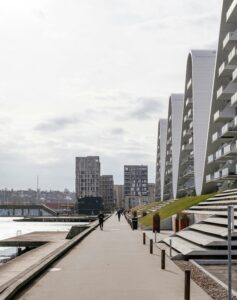
In this article, I address the issue ofnew housing needswithin a social context that is very different from the one that gave rise to Italy’s residentialbuilding stockin the 1960s and 1970s.
I evaluate, from various perspectives, the foundations for what promises to be a major residential redevelopment process in the coming years and a possible approach derived from the German experience.
New Housing Models: The Situation in Europe and Italy
In Europe, the“Living”sector accounts for 26% of total real estate investments, up 17% since 2014.Projections indicate 33% within five years.
In 2025, residential investments in Italy reached1.2 billion euros, up 40% from the previous year. This represents a significant rebound, albeit from a still-low base. In the first quarter of 2026 alone, investment volumes doubled compared to the same period in 2025.
The response that is currently taking shape, in fact, encompasses all types of housing—including unconventional ones—such as co-living, student housing, senior housing, and build-to-rent, and has become thesecond-most attractive real estate asset for institutional investorsin Europe.
Rents rose by 28.7% between 2021 and 2025. Residential building permits fell by 20% during the same period. This represents a structural imbalance between supply and demand.
For those who design residential buildings, knowing these figures isn’t just a matter of general financial knowledge—it’s about understanding the market in which they operate and the questions that market is raising.
New Housing Models: A Demographic Perspective
Italy’s housing stockwas built for families who today account for only a small portion of the demand: three adults, a home they own, and long-term residency. That was the paradigm of the 20th century.
Today, demand is coming fromincreasingly smaller households, from people living alone, from independent seniors who are not seeking care but rather social connection, from out-of-town students without housing, and from workers on layoff who need a flexible contract.
Each of these profiles reflects a different spatial and temporal need to which the conventional market does not provide adequate solutions.Two figures illustrate the sense of urgency:
- The first issue concernsstudents: in Italy, there are 1.7 million full-time university students and 80,000 beds in student housing, for a coverage rate of 4.9%. The European average is 15%, and 173,000 new beds would be needed to bridge the gap.
- The second concerns theelderly: those over 65 already account for 25% of the population.The coverage rate for senior housing is 1.9%, compared to a minimum target of 5%.If just 1% of those over 65 opted for these solutions, it would generate an immediate demand for 140,000 housing units.
These preconditions can no longer be ignored, and in the coming years, adequate responses will need to be provided to the new demand for housing.
New Housing Models: The Regulatory Perspective
Over the past two years, Italy has enacted threesignificant pieces of legislationon housing.
- The first is the“Salva Casa” Decree(Law 105/2024), which lowered the minimum housing standards for existing buildings and simplified the procedures for addressing formal nonconformities.The changes introduced amend the standard provisions ofthe Consolidated Building Code(Presidential Decree 380/2001), opening up a market that was previously stifled by stricter regulatory thresholds.
- The second isLegislative Decree 29/2024, which implements Law 33/2023 on non-self-sufficiency. Thisdecree explicitly recognizedsenior cohousingandintergenerational cohousingas tools of housing and welfare policy. At the end of 2025, the Ministry published the relevant operational guidelines: for the first time, the Italian legal system is addressing these types of housing in a comprehensive manner.
- The third is the2026 Housing Plan(Decree-Law 66/2026), effective as of May 8, 2026. It has a budget of approximately 10 billion euros and aims to build 100,000 housing units over ten years.The plan focuses on the renovation of existing public housing stock and on public-private partnerships for rent-controlled housing; furthermore, it includes, for the first time, an explicit reference to co-housing as a housing solution to be piloted.
In the coming years, we will see whether these measures will resolve thestructural problem, but they also signal a shift in approach: from new construction to the renovation of existing buildings, from sales to rentals, and from standardization to differentiation based on demand.
This marks the beginning of agreater awarenessof the needs of a sector that has already made its needs known through demands that differ from those of the past.
New Housing Models: A Typological Perspective, the Situation in Germany
Germanyhas solved the problem in a way that, in my opinion, is worth studying.It didn’t invent a single building type; it built a system: four progressive typologies.
- “Barrier-Free,” meaninghousing for independent individuals with limited mobility. Accessibilityis built into the design of the housing units in accordance with DIN 18040, following precise dimensional standards to facilitate the use of the spaces.
- “Betreutes Wohnen,”housing units of approximately 50 square meters for people aged 70–75 and older, with a basic package of services included in the rent and additional services available upon request. Therent is, on average, 20% higher than the standard market rate. Residents choose which support services to activate; a fixed level of care is not imposed on them.
- “Mehrgenerationenhaus,” themultigenerational home: seniors, students, and young families living in the same building, where coexistence is intentionally designed and planned.The common areas—which include shared kitchens, workshops, and gardens—are designed to bring different residents together. The German federal government has funded hundreds of these facilities since 2006.
- “Pflegeheime,” which providespecialized care for those who are no longer able to care for themselves, with high regulatory standards, including for the quality of individual living spaces. Theguiding principle is continuity: the system supports residents over time, adapting to their changing needs as their condition evolves.
TheGerman modelshould not be adopted uncritically; in my view, we need to understand its complexity and the system based on progressive thresholds. The system focuses on people’s natural life course and their temporary needs, which introduce animportant element of flexibilityinto the design of future residential construction.
New Housing Models: A Design Perspective
I believe that what I have just stated is not merely the recognition of anew market category; in conventional construction, a property is built to be sold, whereas in this new context, a service is built to be provided over time.
This difference alters project priorities, the relationship with the client, and the time frame under consideration, which leads to at least three concrete consequences:
- The first concerns thedefinition of design parameters. Beforeaddressing the forms, it is important to precisely define who will live there, for how long, with what degree of autonomy, and with what needs for shared living. The typology is not a given; it is a response to a specific question dictated by practical needs. Conscious development necessarily requires a well-informed and responsible design that excels in its architectural choices.
- The second consequence concernsdurability. Anyone whomanages a rental building has a direct long-term interest in the quality of construction: every poor decision comes back to haunt them in the form of maintenance costs or a vicious cycle of tenant turnover. This further aligns the client’s interests with the quality of the project.
- The third point concerns thestakeholders. “Living”brings together administrators, investors, management professionals, and construction industry professionals. All these stakeholders essentially think in terms of return on investment and replicability. The risk is that these will become the sole criteria for the project and, in effect, render the completed work inadequate, betraying the true motivations underlying this necessary development.
Designers who want to work in this field must speak this language, while also bringing their own knowledge and expertise regarding theregulatory, technical, and compositional aspects. It will therefore be necessary to identify the site’s unique opportunities through in-depth contextual analyses, and, not least, to consider its natural and territorial aspects, taking action in a manner that respects environmental values.
Sources
- JLL, Global Living Investment Universe 2025.
- Nomisma, 18th Report on Housing, Bologna, February 2026.
- Nomisma, Senior Housing in Italy: Figures and Outlook, 2020 (updated 2025).
- Colliers Italia, PBSA Report Italy, March 2026.
- Scenari Immobiliari / Abitare Co, Rental Housing in Italy and Europe, 2026.
- European Investment Bank (EIB), Housing Gap Estimate 2025.
- European Parliament, The Housing Crisis in Europe: Key Data and EU Action, October 2025.
- Council of the European Union, The Housing Crisis in the EU, 2025.
- DLA Piper, Senior Housing in Germany—A Demographic Necessity and Solid Investment.
- Pambianconews.com, “The Living Sector Grows by 40% in 2025,” March 2026.
- INFOBUILD, “Housing Crisis: A True Social Emergency in Europe,” April 2026.
- Decree-Law No. 69 of May 29, 2024, converted into Law No. 105 of July 24, 2024 (Salva Casa Decree).
- Law No. 33 of March 23, 2023 (Reform of Care for the Non-Self-Sufficient).
- Legislative Decree No. 29 of March 15, 2024.
- Decree-Law No. 66 of May 7, 2026 (Housing Plan).
- National Council of Notaries, Study No. 54-2024/P, Agreements on Shared Living Among the Elderly.